
The Medical Representative’s Dilemma
How to Survive a 100k Target for with a Bag of Samples and Zero Wi-Fi
There is a distinct flavor of grit that only those who worked in the Indian pharmaceutical sector in the pre intenet era would truly understand. Today, a sales professional can target thousands of prospects with a single click, track open rates, and automate follow-ups while sipping an artisanal latte. But back when “the net” was just something Kapil Dev used for cricket practice, entering the world of pharmaceutical selling wasn’t a lifestyle choice; it was an extreme sport.
Jobs were scarcer than an Ambassador car without a waiting list. Whether you had a passion for the art of persuasion or simply needed to pay rent, the universe frequently made the choice for you. When the economic going gets tough, the tough get going. There I was, heavy leather bag in hand, making a silent vow to stand on my own two legs. Frankly, there was no other go!

Photo by UK Black Tech on Unsplash
The Daily Grind: Anatomy of a Pharma Hustle
To understand the unique dilemma of an old-school Medical Representative(MR), you have to understand the daily math. The job description was deceptively simple: walk until your shoes wear thin, smile through the standard Indian humidity, and hit your daily baseline. That baseline was a rigid, non-negotiable formula: 10 doctors and 5 chemists every single day.
The Cycle of the Prescription
In our ecosystem, you didn’t sell a product directly to the end consumer. You engaged in a delicate, three-tier dance of persuasion:
- The Pitch: Convince the physician that your product was superior.
- The Prescription: The doctor writes the brand name on their pad with a fountain pen.
- The Fulfillment: The patient takes that paper to the local pharmacy.
Only when those three stars aligned did a sales conversion actually happen. There was a unique, almost addictive thrill in standing near a wooden pharmacy counter, watching a patient hand over a script featuring your product. You’d watch the chemist pull the box from the shelf, ring it up on a manual cash register, and collect the cash. Boom. Sale made.
When the Chain Breaks
But this cycle also exposed us to a heartbreaking reality. Sometimes, a patient would look at the final bill, quietly shrug, and walk away because the medicines were way beyond their means. In pre-liberalization India, where health insurance was practically non-existent, the macro-economics of healthcare hit you right in the face. The doctor was convinced, the chemist was stocked, but the sales cycle collapsed at the final hurdle.
On good days, hitting the 10+5 quota felt like a breeze. The waiting rooms cleared quickly, the doctors were receptive, and the chemists were cheerful. But on the bad days? You’d find yourself stranded at 7:30 PM, soaked in sweat, having seen only 7 doctors, facing the grim prospect of explaining your missing numbers to a Regional Manager who looked at metrics the way a hawk looks at field mice.
Decoding the Territory: From HQ to the Outstations
If managing the daily headcount wasn’t enough, the logistical puzzle of the monthly master list added an entirely new layer of complexity. A typical Representative carried a universe of 250 to 300 doctors to cover within a four-week window.
[ Your Base Territory: HQ City ]
│
┌────────────────┴────────────────┐
▼ ▼
[ Ex-HQ Towns ] [ Outstation Territory ]
- Daytime bus travel • Multi-day expeditions
- Home by evening • Budget hotel living
- Rapid-fire visits • Full town saturation
Navigating the Geography of Targets
The majority of your list resided safely within your Headquarter (HQ) city. You knew the shortcuts, the clinic timings, and which tea stalls served the best cutting chai while you waited out a doctor’s three-hour surgery delay.
Then came the peripheral territories:
- Ex-HQ Towns: These were neighboring towns far enough to require an early morning state transport bus ride, but close enough that you could crawl back into your own bed by nightfall.
- Outstations: These were the true tests of endurance. Traveling to an outstation meant packing a suitcase, booking a fan-cooled budget hotel room, and staying put for days at a time. You had to systematically map out every clinic and pharmacy in that town before you could justify heading back home via a bumpy steam-train or bus ride.
The French Connection and Flawless Preparations
Working for a prominent French multinational firm added a layer of prestige—and immense pressure—to the job. This was a company with branches spanning the globe, which meant their standards were sky-high, even if the local infrastructure wasn’t. While domestic companies might play fast and loose, a French MNC expected European precision.
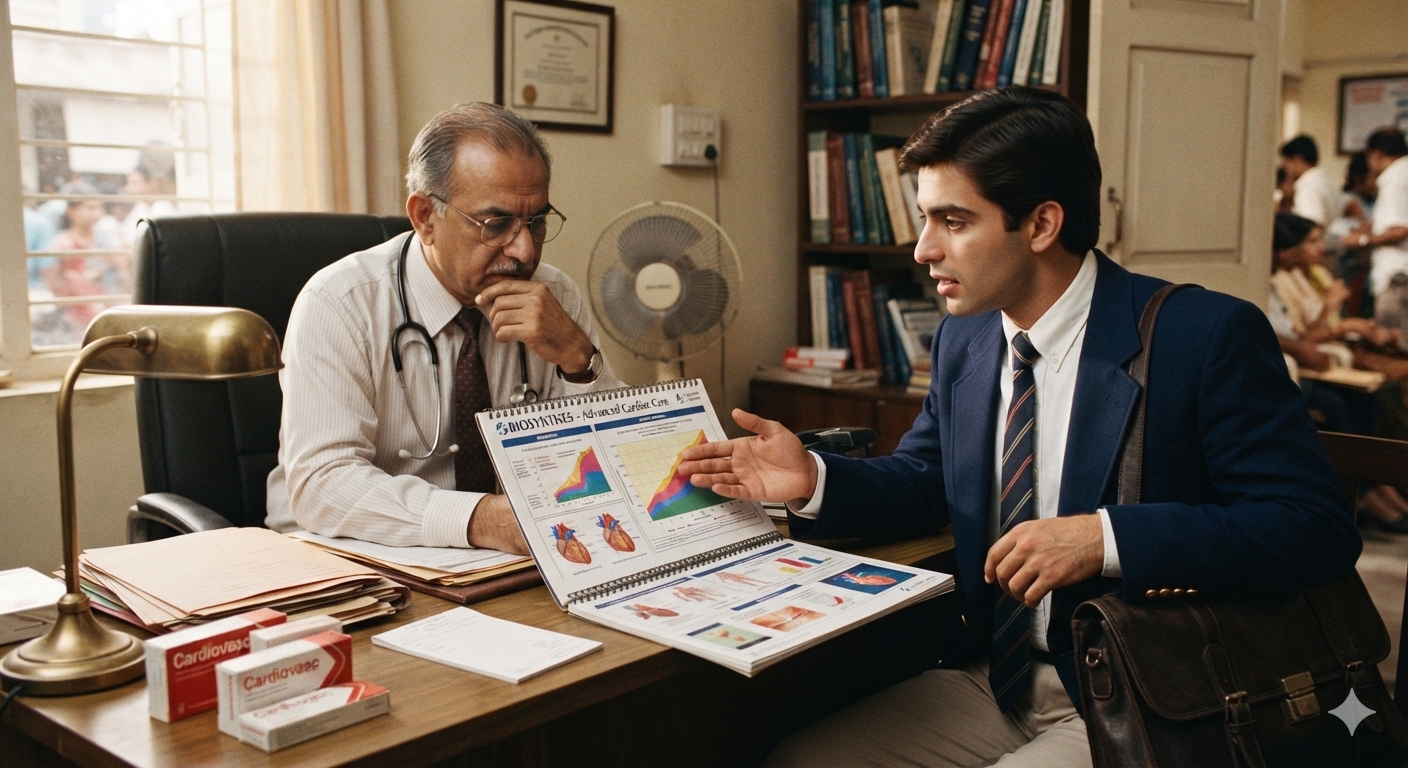
In pharmaceutical selling during the 80s and 90s, your visual aid—the heavy, spiral-bound flip chart detailing drug efficacy, clinical trials, and comparative data—was your only weapon. Your preparations had to be flawless because you were representing global science.
Mastering the Five-Minute Window
You had to know your medical literature inside out. If a doctor challenged your drug’s bioavailability vs. a competitor’s, you couldn’t say, “Let me email you the PDF.” You had to flip directly to page 14 of your folder, point to the graph, and deliver the answer with absolute conviction.
Your mental checklist before stepping into a clinic required meticulous attention to detail:
- Ensuring your branded sample packs were immaculate and unbent.
- Verifying that you had the exact scientific catchphrases memorized for your sales presentation.
- Confirming the chemist next door actually had the stock imported or distributed ready before you promised the doctor it was available.
The Astro-Medical Consultation: An Unforgettable Pitch
Of course, no amount of rigorous preparations could brace you for the sheer eccentricity of some of our medical pioneers. Enter Dr. Banerjee, a legendary practitioner in an Outstation town who was as famous for his diagnostic skills as he was for his absolute obsession with Vedic astrology.
I had waited three hours in a sweltering waiting room to pitch our premium flagship antibiotic. When I finally crossed the threshold, I opened my mouth to deliver a beautifully rehearsed, scientifically backed opening line. Dr. Banerjee held up a single, authoritative finger, silencing me instantly.
“Stop,” he whispered, peering over his reading glasses. “Do not speak. Put the folder away. Show me your right palm.”

Photo by Mikhail Nilov: https://www.pexels.com/photo/man-with-stethoscope-around-his-neck-7407049/
Confused but terrified of losing the visit, I extended my hand across the desk. He grabbed my wrist, pulled a brass magnifying glass from his drawer, and studied my palm for two agonizing minutes. The silence was broken only by the rhythmic creaking of a rusty ceiling fan.
“Aha!” he suddenly shouted, slapping the desk. “Jupiter is entering your tenth house this week. Your stars are perfectly aligned for prosperity. However, your liver line looks slightly stressed. Do you drink enough water?”
“I… I try to, Doctor,” I stammered, completely derailed from my pitch.
“Excellent. Because your Jupiter is strong, I shall trust your French company. I will prescribe your antibiotic for five patients tomorrow. But you must wear a yellow shirt on Thursdays to keep the luck flowing.”
I walked out of his cabin completely bewildered, my flawless sales presentation entirely untouched, but with five guaranteed prescriptions in the bag. Naturally, for the rest of my stint in that territory, Thursday became my mandatory yellow-shirt day. You don’t argue with Jupiter when you have a target to meet!
The Final Countdown: Staring Down the 100k Target
Every bit of this daily legwork, astrological maneuvering, and rigorous practice converged on a single, terrifying number. My monthly target was ₹1 lac—a cool hundred thousand rupees. In the 1980s, when a brand-new Maruti 800 cost around ₹75,000, a one-lakh target felt like trying to climb Mount Everest in flip-flops.
When you weren’t reading palms, the sales presentation was a high-stakes performance. You had exactly two to three minutes to make an impact before the next Representative knocked on the door. You had to read the doctor’s body language: Were they glancing at their watch? Were they genuinely interested in the sophisticated molecular research from your French headquarters, or did they just want you to leave the free samples and clear the room?
Resolving the Representative’s Dilemma
This is where the ultimate dilemma of the profession took root. How do you push for steep commercial targets while maintaining ethical medical standards? How do you convince a doctor to alter their prescribing habits based purely on the merits of your detailer, while knowing your entire month’s livelihood rests on whether they write your brand name on that little pad?
Real sales were built on trust, sweat, and a pair of very tired feet.
The Waiting Room Wars: Survival of the Wittiest
Of course, the dilemma wasn’t just convincing the doctor; it was surviving the hallway battle to even get through the door. The clinic waiting room was an analog battlefield, a tight space packed with fifteen Medical Representatives from rival companies, all clutching their leather bags like shields. We were a brotherhood, yes, but we were a brotherhood with competing quarterly quotas.
My fiercest rival was Sharma, a veteran Representative for a local generic manufacturer who knew every trick in the book. One rainy evening in an Ex-HQ town, we were both vying to see the area’s top pediatrician. The waiting room was chaotic, and the doctor’s peon (the absolute gatekeeper of our destiny) was looking increasingly irritated by our constant hovering.
Sharma tried a psychological maneuver. He looked at his watch, sighed loudly, and turned to me. “Hey, I just heard Dr. Kapoor has an emergency delivery at the hospital in twenty minutes. He’s going to rush out. No point waiting.”

It was a classic “phantom emergency” trick designed to make rookies pack up and leave. But I had done my preparations. I knew Dr. Kapoor’s hospital rounds were strictly in the morning. Instead of leaving, I deployed a counter-strategy: the Samosa Gambit. I slipped out for five minutes, returned with a plate of hot, steaming samosas from the tea stall next door, and quietly gifted them to the exhausted peon.
As Sharma watched in horror, the peon wiped his greasy fingers, looked at his token sheet, and signaled me next. “Tum pehle jao, French company,” he whispered. Sharma’s jaw dropped. I walked into the cabin, delivered a flawless sales presentation, and secured the pediatric drops quota for the month. In the pre-internet era, market intelligence was great, but hot snacks were faster!
From the Waiting Room to the Boardroom: A Lasting Legacy
Looking back at that intense window of those grueling days on the road did far more than just help me clear a ₹1 lac target for a French MNC. They became the foundational bedrock of my entire professional journey. When you spend your formative years navigating the delicate psychology of eccentric doctors, outsmarting clever competitors in cramped waiting rooms, and facing the daily pressure of a hard target, you develop a corporate skin thick enough to withstand any modern business crisis.
The pharmaceutical selling landscape taught me how to read a room in seconds—a skill that became invaluable later in my career when pitching to tight-fisted boardrooms or managing cross-functional global teams. It taught me resilience; after you’ve spent three hours under a broken fan in an outstation town just to be rejected in thirty seconds, a missed corporate deadline or a difficult client email feels like a walk in the park!
Most importantly, it stripped away any illusion that success can be automated. Today’s corporate world is obsessed with digital funnels, automated CRM pipelines, and AI-driven metrics. But my time on the pavement proved that long-term business growth relies on human connection. The grit, the quick wit, and the empathy required to solve the Medical Representative’s dilemma all those years ago are the exact same traits that drive impactful leadership today. I may have traded my heavy leather sample bag for a laptop, but the lessons learned on those dusty roads still guide every single step I take.
Thank you for reading this upto here! Hats off to you! Please comment below if you liked any part that resonated with you. Catch up in my next narration!

Recent Comments